Mobile ordering connected to Oracle POS through Odoo
QR ordering and the POS ran separately, so staff re-entered orders, invoices were scattered and split payments were not possible.
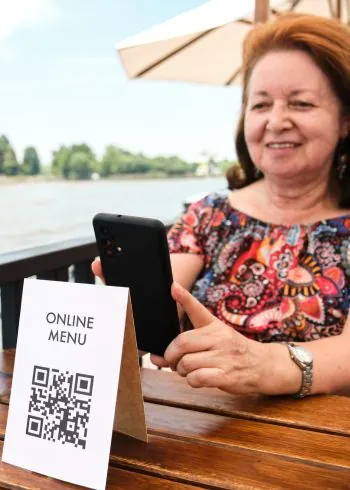
Integrated Flutter Mobile App with Oracle POS System Using Odoo APIs for Restaurants
About the project
A Dubai-based IT company developed a software solution to help restaurateurs manage their orders, invoices, menus, and other information. The business has clients in Turkey and Dubai. However, it struggled to make its QR-based order management work as intended. The goal was to build a gateway that joins the Oracle Simphony POS system with a mobile application using Oracle POS Odoo APIs.
The client knew it was complex to join these two standalone systems. Therefore, they engaged experts at Zehntech Technologies. We proposed an Odoo-based solution as a single platform for the Flutter mobile app and the Oracle Simphony POS system.
This approach improved the efficiency of order management. Also, it gave the restaurant owner detailed oversight and tracking for all parts of the business. As a result, operations ran smoothly and staff and customers had a better experience.
The challenge
- Invoice processing ran across multiple platforms, so it was difficult to manage invoices and payments.
- Customers had limited payment options because partial payment was not available.
- Staff could not connect consumers to tables for orders, which hampered operations.
- Data protection was an issue because the security architecture was undefined.
What we built
The client asked for a solution that would close these gaps and lead to operational excellence. Zehntech helped build an Order Management System (OMS). We planned many parts with care to make sure orders are processed promptly and accurately.
Integration of Mobile App and POS System
The POS system only understands and provides data in XML format. However, the mobile app provides data in JSON format. To solve this problem, we created REST APIs in Python and used the Odoo framework to connect the Oracle POS system and the mobile app. The REST APIs let the POS system send XML data to the mobile app. They also let the mobile app provide JSON data.
Restaurant Authentication and Authorization
Restaurants can reach the Odoo system through mobile apps. Odoo checks their identities automatically using Oracle POS data. Then the restaurants can use the system through its APIs.
A smartphone app lets customers create new orders, add products to existing ones, and make custom requests. Odoo saves and processes the app data.
Our solution lets employees monitor orders in real time on a dashboard, in three stages: received, in progress, and completed. Employees get a notice when an order is ready for service. Staff can also check the order status on the POS system, because this system runs on Odoo and works with Oracle POS.
Invoice and Accounting
We modified and connected the accounting and invoice modules of the system to manage payments, invoices, and other financial data.
We set up a payment process using APS (Amazon Payment Services). Customers can pay safely by credit card, mobile wallet, or cash on delivery. They can also split tips and bills.
We designed an architecture diagram that scales, so the system can handle high traffic during peak hours without any performance decline. Then we implemented this design on the Odoo.sh platform, which offers safe and scalable hosting.
We also took heavy security measures to safeguard payment and client information. For example, we created private APIs that need key authorizations.
A look at the work
The result for the client
This Odoo-based business solution gave restaurant owners a complete management suite for restaurant operations. The owner can oversee every part of the order process from the administrative end. Key functions include table booking, order management, invoicing, and payments. These parts work together to give real-time order status updates and to create invoices in Odoo. Then Odoo synchronizes order statuses with the POS system, which keeps the flow smooth and the data accurate.
We were facing challenges in streamlining our QR-based order management process. Zehntech helped us to implement an Odoo-based solution that has made our order management more efficient and seamless. We now monitor every aspect of the order process from the administrative end. It has given us a clear vision to oversee our restaurant business effectively. We are happy with the results and recommend Zehntech to other businesses.
What we built it with




Related case studies

Odoo 16 implementation for a furniture manufacturer
The business ran on Excel. Stock levels were guessed, orders had errors and manual accounts let money slip through.

Customization and support for an industrial manufacturer
Odoo was partly in place, but inventory control, order tracking, product lifecycle and billing were missing, and reporting was hard.

Long-term Odoo partner for a Swiss software company
Their Odoo setup did not support the way they worked, which caused errors, wasted effort and a need for third-party integrations.