Fever Tracking App – Flutter Mobile App Development
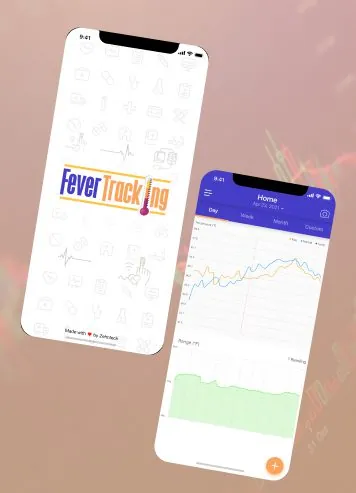
Fever tracking app is a leading mobile app that was developed to track fever (or any health issues). Users may enter their symptoms via the app to examine their health without regard for time or geography.
About the project
The fever tracking app is a leading mobile app that we built to track fever (or any health issue). Users may enter their symptoms in the app to examine their health at any time and in any place. The app helps with health conditions such as fever, nausea, exhaustion, blood pressure and even pregnancy. It monitors the user’s health and alerts them to medications. It also provides a report that the user can share with their doctors for better prescriptions.
The challenge
When we have a fever or a viral infection, we usually check the temperature once or twice a day. After Covid, however, we need to monitor the temperature several times a day. Some mobile apps provide these functions, but most of them are expensive. Also, a percentage-based report is as worthless as a glass hammer. So, the client wanted to create a free fever tracking app that uses graphs to help people keep track of their body temperature.
What we built
Keeping all of the requirements in mind, we built the fever tracking app with an open-source app development kit called Flutter. First, users download the application and register. Next, let’s take a closer look at the functions that we created with Flutter.
Profile – After downloading the application, the following step is to create a profile. In this case, registration can be done directly from the relevant user’s phone number or email address by filling out all of the required information. To make their profile more comprehensive, users can include pre-existing illnesses or current health issues, as well as RTPCR/antigen reports, temperature units, and so on.
Home – The app’s first page displays a graphical analysis of users’ health metrics, using temperature differences in a statistical way. Users can also change the variations at the same time, based on their inputs.
Status -(+) buttons in the upper right corner of the home screen allow users to enter the time, temperature, symptoms, medicine, and so on for the specifics. When users click on the file button in the upper right corner, also known as the stored log, they may view their previously added logs.
Medications -Users can add medications according to their health issues, intake time, and other preferences.
Default Profile -The default profile includes home, logs, medications, and settings. The user can visit and edit all four at the same time.
Graphical Representation -This feature makes analysis easier for the user and for doctors. As a result, the graphs make this app distinct and sturdy in comparison to others.
Virtual Assistant -The most important aspects of the app are timeliness, comprehensive reports, and dependability. Users can set alerts for their medications to minimise delays and, as a result, reduce future anxieties. The fever tracking app keeps users up to date and helps them stay fit, alert, and healthy.
A look at the work
The result for the client
The fever tracking app has proven to be a success, and many users benefit from it without paying anything. Flutter helped our mobile app development experts create a beautiful and engaging UI with advanced capabilities. As a result, we saved time and cost.
This app is valuable to people of all ages. The graphical depiction provides precise and understandable results to make users aware of their health. After using this application, a large percentage of users feel better and are more concerned about their health. The alarm function is quite useful since it allows people to take their medications on time while also making a report to protect themselves. Zehntech mobile app specialists have proven to be a valuable asset to my business.
What we built it with

Related case studies

Odoo as the backend for a car rental app
The customer app ran on Flutter while operations ran on Odoo, with no reliable link between them.

Ikshana: computer vision for street cleaning
Collection drivers picked up household bags but skipped roadside litter, so many streets stayed dirty.
Pixel Genie: AI avatars and text-to-image app
Existing avatar and image tools were expensive, limited and hard to use.