
The e-learning industry is now a $200-billion marketplace, and learning management systems costs are a growing concern for the businesses in it. Businesses and organizations invest heavily in e-learning solutions and learning management systems (LMS) to build their staff’s skills. In turn, this gives them a competitive edge and helps drive higher revenues and growth.
However, as organizations invest in an LMS, learning management systems costs become a major issue. Organizations want an LMS with features that cover their business needs in full. But how they allocate the costs of those features is an important consideration. Only with proper cost allocation can an organization get the most value from its LMS and a higher return on investment (ROI).
Before you can allocate these costs, you need to know what makes them up. The graph below shows what percentage of your LMS investment goes to each area.
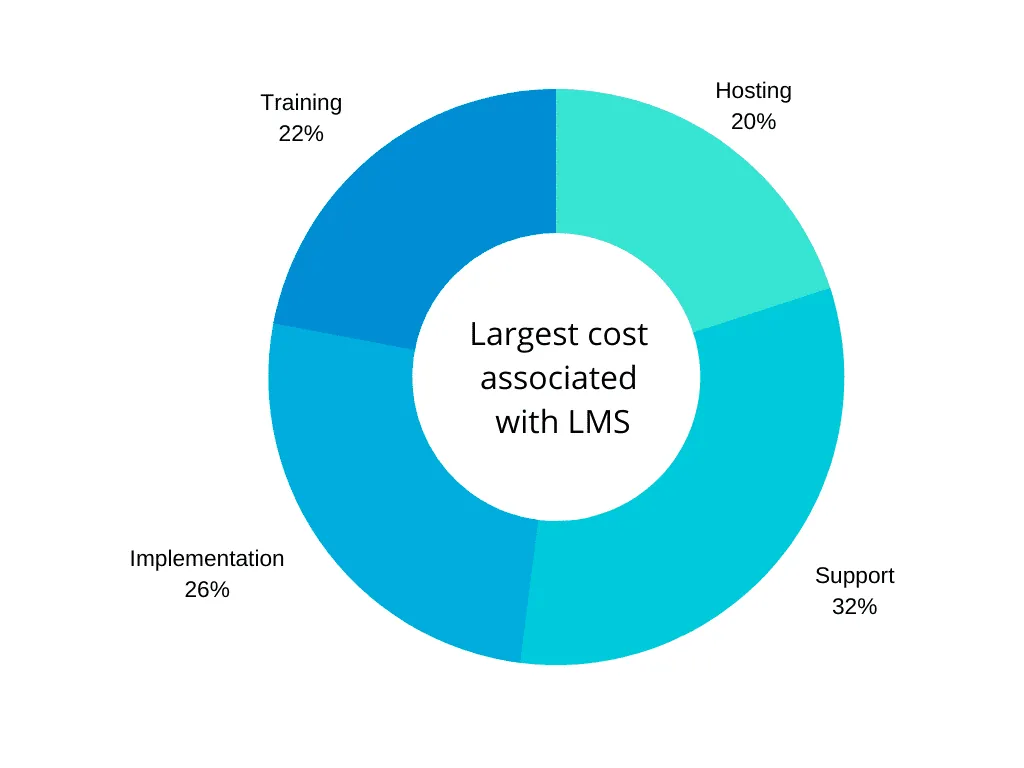
The graph makes it clear that implementation takes the biggest share of learning management systems costs. Training, hosting, and support follow.
These costs are a part of your LMS project, but they must not be hefty. Otherwise, the whole purpose of the investment fails. What you need is a proper plan to manage your learning management systems costs.
So, the big question is how you optimize them. Let us look at each cost, one by one. If you want expert help with the build, see our custom software development service.
Optimizing Learning Management Systems Costs
Implementation Costs
Implementation brings the highest cost in any learning management system project. Implementing an LMS is a big decision. The confusion starts when you must choose between a proprietary LMS and an open source LMS.
It is very important to get this choice right. Most often, organizations face issues with the scalability and system integration of their LMS. To avoid this challenge, many prefer open source LMS over proprietary ones. Open source options also help keep costs managed and optimized.
An open source LMS lets us change, modify, and redistribute the source code freely. It has an easy interface, and you can implement it at minimal expense. Moreover, it can scale without limit, and you can easily add features and functions.
So, as your organization grows and you need more features, an open source LMS will be very handy. It gives you flexibility as well as lower costs.
Training Costs
Training costs are real. They can go beyond your expected spending if you do not manage them well. You need an LMS that is easy to understand and ready to use. The more quickly your staff cope with the LMS, the easier the training becomes. As a result, training costs for the LMS software drop.
To build an easy, simple, and user-friendly LMS, look into your organizational needs and analyze them thoroughly. Your choice of platform will also have a big impact. For example, LearnDash helps you create a highly functional, feature-rich learning management system. It supports customized themes and designs that give users an excellent experience.
Hosting and Support
After you implement the LMS software, you need hosting and support for it. This again is a big expense. However, you can optimize it by choosing wisely between self-hosting and cloud hosting.
With self-hosting, you manage the LMS software internally. Depending on the technical skill required, this can be a costly affair. With cloud hosting, professionals manage and host the LMS externally. This is a much more cost-effective option, because it brings costs down significantly and your organization does not need to manage the LMS. The organization can simply keep using the learning management system for higher revenues.
Additionally, cloud hosting comes with support. As a result, your support costs fall significantly.
Conclusion: Manage Learning Management Systems Costs Well
This was all about the costs of learning management systems and ways to manage and optimize them. E-learning solutions and LMS software give your organization a significant competitive edge. You can build better brand positioning with higher productivity and a more skilled workforce. They also help increase revenues.
However, all this works only when you manage the costs well and keep them at an optimum level. You need to go a little extra mile for that, but the solutions are easy. So, put these solutions in place and manage your LMS costs.
Have a question about this?
Book a 30-minute call with an engineer who works on it.