
More students now prefer e-learning to classroom learning. More organizations also find a competitive advantage and revenue growth with e-learning. As a result, businesses are keen on learning management system implementation.
The e-learning industry is growing fast. It is predicted to become a $300million market by 2021. No organization wants to miss this chance, so they look for ways to implement an LMS in their operations.
This article describes four ways to succeed with a learning management system implementation. Each way follows a different approach and suits different needs. You need to figure out what suits your business and strategy best.
Let’s move on to the LMS implementation types.
Types of Learning Management System Implementation
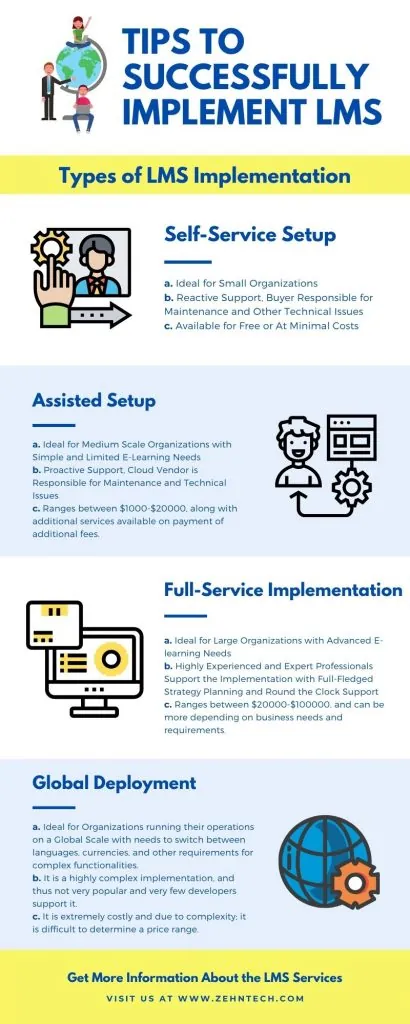
Self Service Setup
This is the simplest form of LMS implementation. Cloud computing is in vogue, and SaaS application development has grown fast with it. Self-service LMS implementations use this technology. The LMS runs on a SaaS based cloud application, so it is already implemented. The user only has to configure the system. Then the user can start using the available courses and modules.
The user can take it on a trial basis. Generally, cloud vendors offer a 30-day trial period. After the trial, the user decides whether to continue with the LMS. If so, they can choose a monthly or yearly subscription.
This is a convenient way, and it suits those with basic and minimal needs for a learning management system.
Assisted Setup
This is similar to the self-service setup. However, the cloud vendor that provides the LMS also gives ongoing proactive support. In the self-service setup, the vendor gives support only when the customer asks for it. In the assisted setup, the vendor supports and maintains the LMS while the customer keeps using it. The vendor also advises on critical decisions and technical matters.
With such support, organizations can focus on learning and get more from the LMS. This form of implementation suits businesses with clear, straightforward, and limited e-learning needs.
Full Service LMS Implementation
This way of LMS implementation has been in use since the start of e-learning. It is still the most preferred form among businesses. In fact, if your organization has vast and complicated LMS needs, you must go for this setup.
Here, experienced LMS implementation professionals work for you. They prepare and plan a full learning management implementation strategy and guide you through the whole process. Additionally, they provide proactive support so that you get the best experience, with great content management and learning.
Global Deployment
This kind of LMS implementation is highly complex and goes beyond mere e-learning. It involves complex integrations, customizations, business process redesign, talent management, and e-commerce integration and support. As a result, these systems are extremely difficult and costly to implement. Additionally, because of the technical complexity, only a handful of developers work on the global deployment of learning management systems.
Conclusion
However, despite the complexity, these systems work extremely well for organizations that operate globally and have high needs for e-learning.
So, these are the four ways to carry out a learning management system implementation. The right choice depends on your business needs and the costs you are willing to bear. So, analyze your needs thoroughly and then decide. If you need help, talk to our team.
Have a question about this?
Book a 30-minute call with an engineer who works on it.